Purpose of the Laboratory
Space Systems Design and Test Laboratory (USTTL) carries out research and application studies on the design, development, integration, and testing of small satellite and CubeSat systems. The laboratory aims to provide students and researchers with practical experience in space systems engineering, contribute to the development of domestic satellite technologies, and support the verification processes of subsystems that can be used in space missions.
Scope of the Laboratory
USTTL is the laboratory where ITUpSAT1, Turkey’s first CubeSat, was developed. The launch of ITUpSAT1 shortly after the CubeSat concept entered the global literature demonstrates the laboratory’s pioneering role in small satellite technologies. The laboratory provides a versatile research infrastructure in the field of space systems through satellite design, subsystem development, electronic prototyping, clean room integration, environmental testing, ground station activities, and educational studies.
Research and Application Areas
Research activities carried out within the laboratory focus mainly on small satellite and CubeSat technologies, including the following areas:
- CubeSat and small satellite mission design
- Satellite systems engineering and mission analysis
- Satellite attitude determination and control systems
- Satellite data handling and onboard computer systems
- Satellite communication systems and ground station activities
- Satellite power systems
- Satellite structural and thermal design
- Satellite optical systems
- Propulsion systems and spacecraft subsystems
- Space electronics design and prototyping
- Thermal vacuum, vibration, and environmental testing
- Model satellite, CanSat, and educational space systems studies
Satellite Projects and Experience
USTTL has contributed to the design, production, integration, testing, and tracking activities of various small satellite and CubeSat projects, particularly ITUpSAT1. The laboratory’s experience includes satellite projects such as TURKSAT 3USAT, UBAKUSAT, BEEAGLESAT, HAVELSAT, ASELSAT, SHARJAHSAT-1, and PAUSAT. These studies show that the laboratory plays an active role not only in academic research, but also in applied engineering processes for real satellite missions.
Clean Room Infrastructure
The Class 1000 clean room within USTTL has an area of 25 m². This clean room also houses the thermal vacuum chamber, which provides pressure and temperature control, and was used for the integration and thermal vacuum testing of the ITUpSAT1 flight model. Through its control unit, temperature, humidity, and pressure can be controlled inside the clean room to create the required environmental conditions for different applications. The laboratory also includes a Class 100,000 clean room with an effective area of 8 m², which can be used for educational and experimental studies.
Testing and Production Infrastructure
The laboratory has various infrastructure facilities that support the design, production, integration, and testing processes of small satellite systems:
- Thermal Vacuum Chamber: Used to simulate the vacuum and temperature conditions that spacecraft encounter in the space environment.
- Thermal Vacuum System: Has a volume of 350 liters, a pressure level of 10-5 Pascal, a temperature range from -60 °C to 125 °C, and a temperature control capability of 1 °C/s.
- Vibration Test Setup: Used to test the resistance of satellites and space systems against vibration loads encountered during launch.
- LPKF ProtoMat S100 PCB Milling Machine: Used for rapid production of original space electronics prototypes and circuit boards.
- Rapid Prototyping Infrastructure: Supports design verification and prototype production processes for satellite and subsystem components.
- Ground Station Infrastructure: Used for satellite tracking, communication, and data collection activities.
Thermal Vacuum Tests
Thermal vacuum tests are carried out to simulate the low-pressure and variable-temperature conditions that spacecraft encounter in orbit. Through these tests, the power, resistance, durability, and environmental compatibility performance of developed satellite components can be evaluated. The thermal vacuum infrastructure at USTTL can be used for testing systems developed within both academic projects and industrial collaborations.
Vibration Tests
Satellite systems are exposed to high levels of vibration and mechanical loads during launch. The vibration testing infrastructure used within USTTL is used to evaluate the launch-environment durability of satellites and satellite subsystems. This infrastructure was also used in the launch-condition resistance tests of ITUpSAT1 and has the capacity to support various industrial projects.
Electronic Prototyping
The LPKF ProtoMat S100 rapid PCB milling machine in the laboratory is used for the development of prototype space electronics systems with original designs. This infrastructure supports satellite payload circuits, attitude systems, experimental electronic boards, and various circuit prototyping activities within the faculty.
Activities and Collaborations
USTTL operates within the scope of satellite development, ground station use, satellite tracking activities, thermal vacuum tests, model satellite and CubeSat training, industrial testing activities, and undergraduate/graduate research projects. In addition to academic studies, the laboratory infrastructure is also used in space systems applications for public, industrial, and international collaborations.
Education and Student Participation
USTTL provides a research environment where students can gain hands-on experience in satellite technologies. The laboratory offers opportunities to work and learn in areas such as satellite attitude determination and control, data handling systems, communication systems, power systems, structural and thermal design, optical systems, and propulsion systems.
Laboratory Management and Team
The laboratory is run by academic staff and a research team working in the field of space systems.
- Prof. Dr. Alim Rustem Aslan: Laboratory Manager
- Onur Oztekin: Chief Engineer / Designer
- Bilge Memis: Analysis Lead
- Aybuke Agirbas: Attitude Determination and Control Lead
- Baris Beynek: Thermal Lead
- Yunus Emre Cicek: Test Lead
- Kaan Gokturk: Software Lead
- Rumeysa Ustuncan: Documentation Lead
- Gorkem Can Akilli: Ground Station Lead
- Kaan Sarica: Electronics Lead
Laboratory Images
 Thermal vacuum test infrastructure.
 Satellite integration and electronics work area.
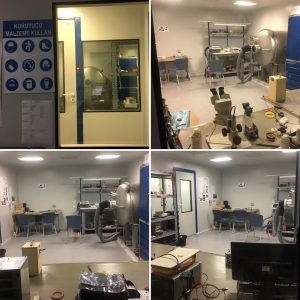 Clean room infrastructure.
 Vibration test setup.
Contact
Laboratory Email: usttl@itu.edu.tr
Laboratory Phone: +90 212 285 31 97
Web: https://usttl.itu.edu.tr/
Address: Istanbul Technical University Ayazaga Campus, Faculty of Aeronautics and Astronautics, Sariyer / Istanbul